Lake Texoma Live Bait Manual
Lake Texoma live bait fishing requires understanding seasonal depth shifts, thermocline positioning, and bait movement. This manual breaks down where striped bass hold throughout the year and how professional guides adjust live shad presentations for consistent success.
Quick Answer: How Deep Are Stripers on Lake Texoma?
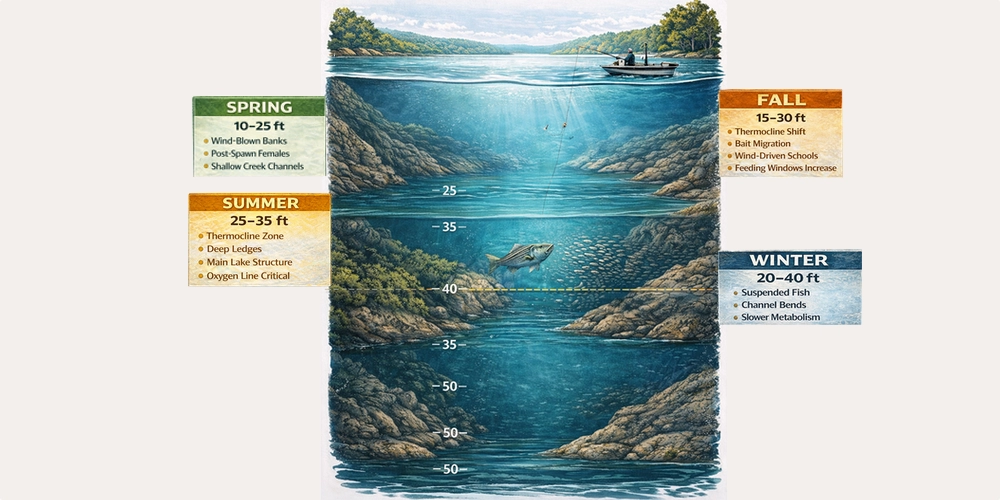
For Lake Texoma live bait fishing, target 10–25 feet in spring, 25–35 feet near the thermocline in summer, 15–30 feet during fall bait migration, and 20–40 feet for suspended winter stripers.
Striper Depth on Lake Texoma
Striped bass on Lake Texoma move vertically throughout the year based on water temperature, oxygen levels, and bait location. In spring, fish push shallow (10–25 ft) along wind-blown banks and creek channels after the spawn. During summer, most stripers hold near the thermocline — typically 25–35 ft — where oxygen levels are stable and bait concentrates. Fall brings bait migration into the 15–30 ft range, while winter stripers often suspend deeper (20–40 ft) around channel bends and structure.
The key to consistent Lake Texoma live bait fishing is depth control. Your bait must be positioned at the same depth as the fish you’re marking on sonar — not above them and not below them.
Professional guides adjust sinker weight, leader length, and boat position constantly to keep live shad in the strike zone.
Why Live Bait Dominates Lake Texoma
If you want to consistently catch striped bass on Lake Texoma, live bait is not optional — it’s foundational.
This is the complete live bait authority guide from professional Lake Texoma striper guide Aaron Sharp.
Everything from catching shad… to tank management… to depth control… to seasonal strategy.
Why Stripers Feed on Shad Year-Round
Lake Texoma has one of the most unique striped bass fisheries in the country. Threadfin and gizzard shad are the primary forage base. Stripers are genetically wired to chase them.
Unlike many reservoirs, Texoma has:
Massive open-water bait populations
Natural striper reproduction (rare in inland lakes)
Strong year-round forage cycles
When bait is abundant, stripers stay healthy, aggressive, and mobile.
Natural Reproduction Advantage
Because Texoma naturally reproduces striped bass, there are multiple year classes present at all times. That means:
2–5 lb “eater” fish
6–10 lb prime fish
15–25 lb trophy class fish
Big fish eat big bait. Period.
When Live Bait Outperforms Artificial
Live bait wins when:
Fish are pressured
Post-frontal conditions hit
Summer thermocline pushes fish deep
Winter metabolism slows
Artificial lures shine in feeding windows.
Live bait shines when fish are neutral.
Threadfin Shad vs Gizzard Shad
Size Differences
Threadfin Shad: 2–4 inches (standard bait)
Gizzard Shad: 5–10+ inches (trophy bait)
When to Use Each
Threadfin
High numbers days
Cold water
Suspended fish
Schooling activity
Gizzard
Targeting trophy stripers
Post-spawn females
Deep summer fish
Low-light ambush situations
Big bait = big predators.
How Professional Guides Catch Shad
This is where amateurs get exposed.
Cast Net Size
5/8 mesh = larger gizzard
1/2 mesh = smaller threadfin
Net Weight Rule
1 pound per radius foot.
A 10-ft net should weigh roughly 10 lbs.
Too light? It won’t sink.
Too heavy? It’s exhausting.
Finding Bait
Professionals don’t randomly throw nets.
They look for:
Marina lights at night
Wind-blown coves
Creek channel bends
Early morning surface flickers
Sonar “cotton ball” bait signatures
Reading Sonar for Bait Balls
On modern electronics:
Dense, rounded clouds = tight bait schools
Scattered specs = pressured or dispersed bait
Bait above thermocline in summer
Bait location determines striper location.
Live Bait Tank Setup (The Hidden Secret)
This is where guides separate themselves.
Most bait dies because of:
Oxygen Saturation
Striped bass need lively bait.
Shad need constant oxygen exchange.
Ammonia Buildup
Dead bait poisons the tank quickly.
Water Temperature Shock
Cold bait into hot tank water = stress.
Hot bait into cold water = shock.
Tank Shape
Round tanks reduce nose injury.
Square tanks cause bait to beat themselves up.
Recirculation vs Raw Water
Recirculation = controlled chemistry
Raw water = fresh but inconsistent temps
Additives
Non-iodized salt
Commercial conditioners (ex: Shad Keeper)
Anti-foam solutions
This is not “fill a bucket and hope.”
It’s system management.
The Lake Texoma Live Bait Rig (Deep Breakdown)
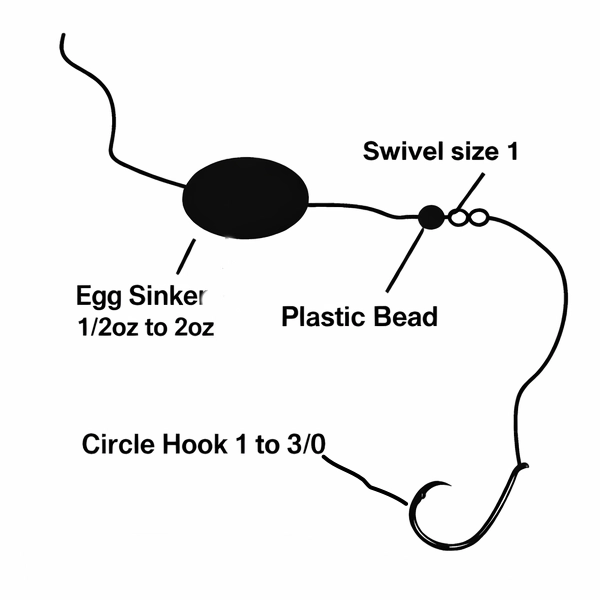
Egg Sinker Size by Depth
10–20 ft: 1/2–1 oz
20–35 ft: 1–2 oz
Deep summer structure: 2–3 oz
Weight should hold bottom without dragging excessively.
Leader Length
18–36 inches typical
Shorter in heavy current
Longer for suspended fish
Hook Size
1/0–3/0 circle hooks.
Why circle hooks?
Better corner hookups
Less gut hooking
Higher landing ratio
Swivel Size
Small but strong. Avoid oversized hardware.
Mono vs Fluorocarbon
Mono = more forgiving
Fluoro = less visible
Free-Line vs Bottom Rig
Free-line: schooling fish
Bottom rig: stacked summer fish
Drift vs Anchor
Drift when fish are roaming
Anchor when fish are stacking
Depth control > boat position.
Seasonal Adjustments
Spring
Post-spawn recovery
Shallow wind-blown banks
Large females recovering
Summer
Thermocline (25–35 ft typical)
Deep ledges
Oxygen concentration zones
Fall
Bait migration
Aggressive feed windows
Wind-driven bait
Winter
Slower metabolism
Suspended fish
Smaller threadfin preference
Seasonal understanding prevents wasted time.
Depth Strategy (The Real Edge)
Most anglers think location matters most.
Professionals know depth matters more.
Suspended Fish
Hovering mid-column above bait.
Bottom Stacking
Summer fish holding tight to structure.
Thermocline Awareness
Stripers avoid low oxygen zones.
Graph Interpretation
Arcs tight to bait = active fish
Long streaks = moving fish
Bottom fuzz = inactive fish
If your bait is not in the strike zone, it doesn’t matter where you are.
Common Live Bait Mistakes
This is why trips fail:
Using stressed or dead shad
Hooking bait through the eyes
Overhandling bait
Wrong sinker weight
Leader too short
Sitting in dead water too long
Live bait requires adjustment.
When to Switch From Live Bait
Professional guides are adaptable.
Switch when:
Surface schooling erupts
Slab bite windows open
Topwater conditions form
High-pressure bluebird days trigger reaction bites
Live bait is dominant — but not exclusive.
Common Live Bait Mistakes
This is why trips fail:
Using stressed or dead shad
Hooking bait through the eyes
Overhandling bait
Wrong sinker weight
Leader too short
Sitting in dead water too long
Live bait requires adjustment.
When to Switch From Live Bait
Professional guides are adaptable.
Switch when:
Surface schooling erupts
Slab bite windows open
Topwater conditions form
High-pressure bluebird days trigger reaction bites
Live bait is dominant — but not exclusive.
Lake Texoma Live Bait Fishing FAQ
What is the best live bait for striped bass on Lake Texoma?
Threadfin shad are the primary forage and work most days, especially when targeting numbers. Larger gizzard shad are better when targeting trophy stripers or bigger fish holding deeper.
How deep should I fish live bait on Lake Texoma?
Striper depth changes seasonally. Spring fish often hold 10–25 feet, summer fish relate to the 25–35 foot thermocline zone, fall fish roam 15–30 feet, and winter stripers suspend deeper around 20–40 feet.
What size hook is best for live bait striper fishing?
Circle hooks in the 1/0 to 3/0 range are ideal. They improve hookup percentage and reduce deep-hooking when fishing live shad.
How do you keep shad alive in a bait tank?
Shad require proper oxygen levels, stable water temperature, and immediate removal of dead bait. Most professional guides use round tanks, strong aeration, and water conditioners to prevent ammonia buildup.
When should I switch from live bait to lures on Lake Texoma?
Switch when stripers are actively schooling on the surface, during strong reaction-bite windows, or when topwater or slab fishing is clearly outperforming bait.
Why Experience Matters
When you hire Aaron Sharp, you’re not just paying for boat time.
You’re paying for:
Bait acquisition skill
Tank management knowledge
Seasonal pattern recognition
Real-time decision making
Electronics interpretation
Depth control mastery
That’s what separates a professional guide from someone with a bait bucket.
Book a Lake Texoma Live Bait Trip
If you want to learn how to fish live shad the right way — and catch stripers consistently — book a trip with Aaron Sharp and experience the difference. Call 580-380-5357
Lake Texoma doesn’t reward guesswork.
It rewards preparation, precision, and professional execution.
Related Lake Texoma Striper Fishing Guides
If you’re planning a Lake Texoma fishing trip or want to deepen your understanding of seasonal striper patterns, depth control, and bait strategy, explore these detailed guides from Sharp Striper Guide Service:
Artificial Lures on Lake Texoma – Learn when reaction baits outperform live shad and how to fish slabs, swimbaits, and topwater effectively.
Winter Deadsticking on Lake Texoma – Cold-water tactics for suspended stripers and how to fish vertically when metabolism slows.
Complete Guide to Striper Fishing on Lake Texoma – A full seasonal breakdown of striper behavior, feeding patterns, thermocline shifts, and depth movement.
Lake Texoma Topwater Lures – When and why stripers explode on the surface and how to capitalize on schooling fish.
Striper Fishing with Live Bait – Detailed rigging setups, threadfin vs. gizzard shad selection, sinker weight adjustments, and depth strategy.